

Jewish Berlin: A Guide to Heritage Sites, History and Memorials
Jewish Berlin is not one neighborhood or one museum. It is a history of more than seven centuries, marked by settlement, expulsion, return, achievement, persecution, murder and renewal, and its traces are spread across the city. The most important places to visit are the New Synagogue and the streets of the Spandauer Vorstadt in Mitte, the Jewish Museum Berlin in Kreuzberg, the Memorial to the Murdered Jews of Europe near the Brandenburg Gate, and the historic Jewish cemeteries in Prenzlauer Berg and Weißensee.
This guide explains what each place is, why it matters and how to visit it respectfully. Opening hours, security procedures and access rules at Jewish institutions and memorials can change, so we have dated our visitor details (October 2026) and recommend checking each official website before you go.
Jewish Berlin at a glance
- Spandauer Vorstadt (Mitte): the New Synagogue – Centrum Judaicum, the Old Jewish Cemetery on Große Hamburger Straße and the Otto Weidt Workshop for the Blind museum, all within a short walk
- Between Hackescher Markt and Alexanderplatz: the site of Berlin’s first synagogue on Heidereutergasse and the Rosenstraße protest memorial
- Kreuzberg: the Jewish Museum Berlin, which covers Jewish history in Germany across the centuries
- Near the Brandenburg Gate: the Memorial to the Murdered Jews of Europe and its underground Information Centre
- Grunewald: the Platform 17 Memorial, from which deportation trains left Berlin
- Prenzlauer Berg and Weißensee: the Schönhauser Allee and Weißensee Jewish cemeteries
- Across the city: Stolpersteine, small brass plaques set into the sidewalk
A short history of Jewish Berlin
The earliest evidence of Jewish life in what is now Berlin is a gravestone from 1244 found in Spandau, and Jews are first mentioned in a Berlin document in 1295. Medieval Jewish life in Brandenburg was repeatedly broken by persecution and expulsion, including the expulsions of 1446, 1510 and 1573.
The continuous history of Berlin’s Jewish community begins in 1671, when Elector Frederick William allowed 50 Jewish families who had been expelled from Vienna to settle in Berlin. They were not permitted a synagogue at first, so their first communal institution was a cemetery. In the eighteenth century, the philosopher Moses Mendelssohn made Berlin a center of the Haskalah, the Jewish Enlightenment.
In the nineteenth century, legal emancipation and industrialization drew Jewish families to the growing city. The New Synagogue, inaugurated in 1866, became the symbol of a confident community that saw itself as both Jewish and German. By the 1920s, Berlin’s Jewish community counted up to 175,000 members, one of the largest in the world, and Jewish Berliners shaped the city’s science, culture, business and politics.
After 1933, the Nazi regime excluded, robbed and persecuted Berlin’s Jews. Deportations from Berlin began in October 1941. By the time of liberation in May 1945, more than 54,000 Berlin Jews had been murdered.
A small number of survivors rebuilt Jewish life after the war. During the Cold War the community split into separate East and West Berlin congregations. Since reunification, Jewish Berlin has become more diverse in its backgrounds, religious practice and identities; the New Synagogue – Centrum Judaicum estimates that more than 20,000 Jews live in Berlin today. Our guide to Berlin’s culture through the years places this history in the wider story of the city.
Is there a Jewish quarter in Berlin?
Not in the sense of an official district. People often search for “Berlin’s Jewish quarter,” and what they usually mean is the Spandauer Vorstadt in Mitte, north of Hackescher Markt. Berlin’s first Jewish institutions were established here from the late seventeenth century, and by the early twentieth century the area held schools, hospitals, synagogues and the New Synagogue’s golden dome. The Scheunenviertel, the part of the Spandauer Vorstadt nearest Alexanderplatz, became a home for Jewish refugees and migrants from Eastern Europe in the early twentieth century.
Even then, Jewish Berliners lived throughout the city, and from the late nineteenth century the Spandauer Vorstadt was only one of many districts with a Jewish population. Today Jewish life is spread across Berlin, and several of the most important heritage sites are far from Mitte.
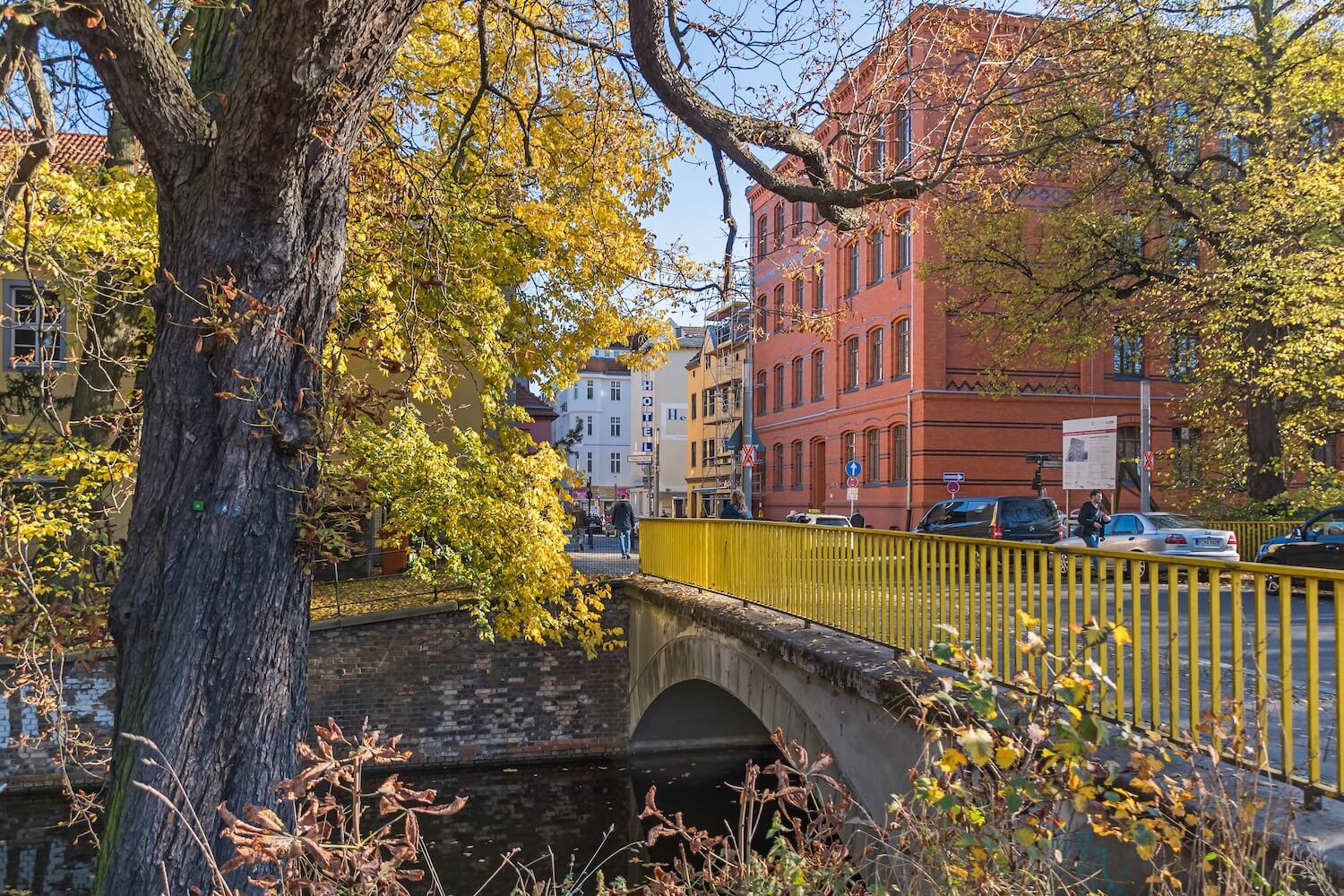
The Spandauer Vorstadt: the historic center of Jewish life
New Synagogue Berlin – Centrum Judaicum
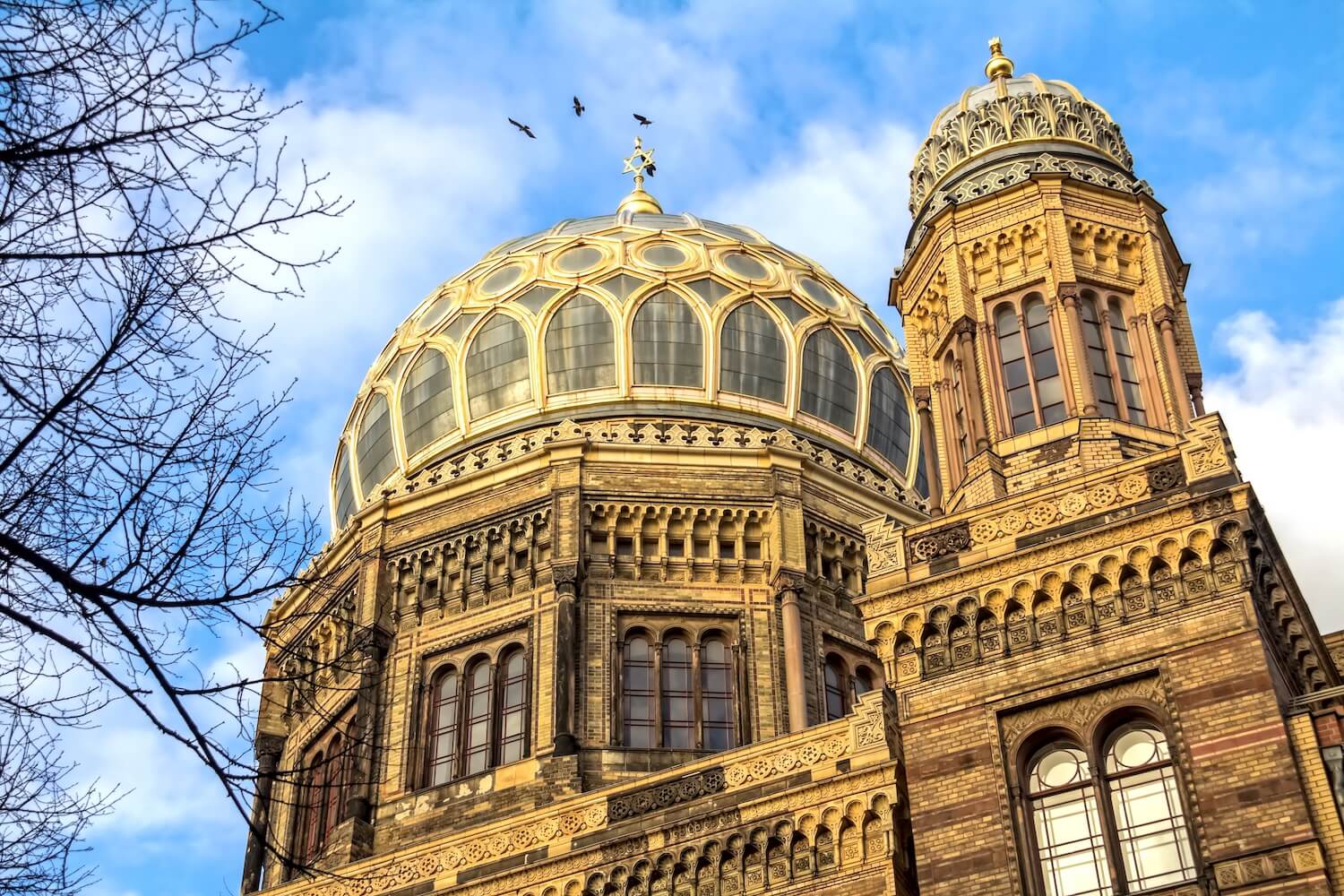
The New Synagogue on Oranienburger Straße was inaugurated in 1866. With 3,200 seats it was the largest synagogue in Germany, and its gilded dome, more than 50 meters high, was visible across the city. Its Moorish style recalled the Alhambra in Granada. It was a center of liberal Judaism, with an organ and a choir of men and women, and in the 1930s it was connected with Regina Jonas, the world’s first ordained female rabbi. The first Jewish Museum in Berlin opened in the building next door on January 24, 1933.
During the November pogroms of 1938, often called “Kristallnacht” in English (historians and memorial institutions now generally prefer “November pogroms”), Nazi attackers tried to set the synagogue alight. Police officers from the precinct at Hackescher Markt, under their chief Wilhelm Krützfeld, intervened and prevented the building from burning down. From 1940 the Wehrmacht used the synagogue as a warehouse, and in November 1943 it was hit in a bombing raid. After the war the ruin stood in the Soviet sector and later in East Berlin; in 1958 the most heavily damaged main sanctuary was demolished, while the street-front buildings were kept as a memorial.
In 1988, the German Democratic Republic established the Stiftung Neue Synagoge Berlin – Centrum Judaicum, which rebuilt the surviving front section. It reopened on May 7, 1995. The space where the main sanctuary stood is left open and marked on the ground. Today the building houses the foundation’s museum and its permanent exhibition, Open Ye the Gates, as well as offices of the Jewish Community of Berlin. A small congregation worships in a prayer room in the historic building.
Visiting: larger bags are not allowed, and visitors should expect security procedures. Check current hours on the Centrum Judaicum website before you go.
Old Jewish Cemetery on Große Hamburger Straße
A short walk north is Berlin’s oldest Jewish cemetery (in German, the Alter Jüdischer Friedhof or Friedhof Große Hamburger Straße), the burial ground of the families who arrived in 1671. It was used from 1672 to 1827, when a Prussian hygiene regulation of 1794, which barred cemeteries in residential areas within the city walls, led the community to open a new cemetery on Schönhauser Allee. By then, the cemetery held 2,767 graves, including that of Moses Mendelssohn.
In 1943, on Gestapo orders, the SS devastated the cemetery, dug trenches through it, shored them up with broken gravestones and desecrated the remains of the dead. In April 1945 the grounds were used as a mass grave for soldiers and civilians killed in the final battle for Berlin, and in the 1970s the East Berlin parks department removed the last remaining Jewish gravestones. What you see today is a quiet green space with a symbolic gravestone for Moses Mendelssohn, which has been re-created several times, and a sarcophagus-like memorial built from fragments of destroyed gravestones.
Next door, the Jewish old people’s home was seized by the Gestapo and used as an assembly camp for deportations from 1942. A memorial plaque and Will Lammert’s sculpture group mark its site. The neighboring former boys’ school, whose precursor was founded in 1778 on Moses Mendelssohn’s initiative, is again a Jewish school.
Museum Blindenwerkstatt Otto Weidt
At Rosenthaler Straße 39, in a courtyard by Hackescher Markt, the Museum Blindenwerkstatt Otto Weidt tells the story of a small workshop whose owner, Otto Weidt, employed mainly blind, visually impaired and hearing-impaired Jewish workers during the Second World War and tried to protect them from deportation. The museum is open daily and is reached by an elevator from the courtyard.
Site of the Old Synagogue and the Rosenstraße memorial
Ten minutes south, near Rosenstraße, a memorial plaque on Heidereutergasse marks the site of Berlin’s first synagogue, consecrated on September 14, 1714. Built to sit no higher than its Christian neighbors, it served the community for more than two centuries and became known as the Old Synagogue once the New Synagogue opened. It was not desecrated in November 1938; its last services took place in November 1942, and it was destroyed by bombs in February 1945. Its foundations were uncovered in 2000. Little remains above ground, which is why the site needs explanation, but it marks the beginning of organized Jewish worship in the city.
Nearby, in Rosenstraße, a sculpture group by Ingeborg Hunzinger commemorates the women who protested in public for days in February and March 1943, often with their children, against the arrest and threatened deportation of their Jewish husbands.
Museums and memorials across the city
Jewish Museum Berlin
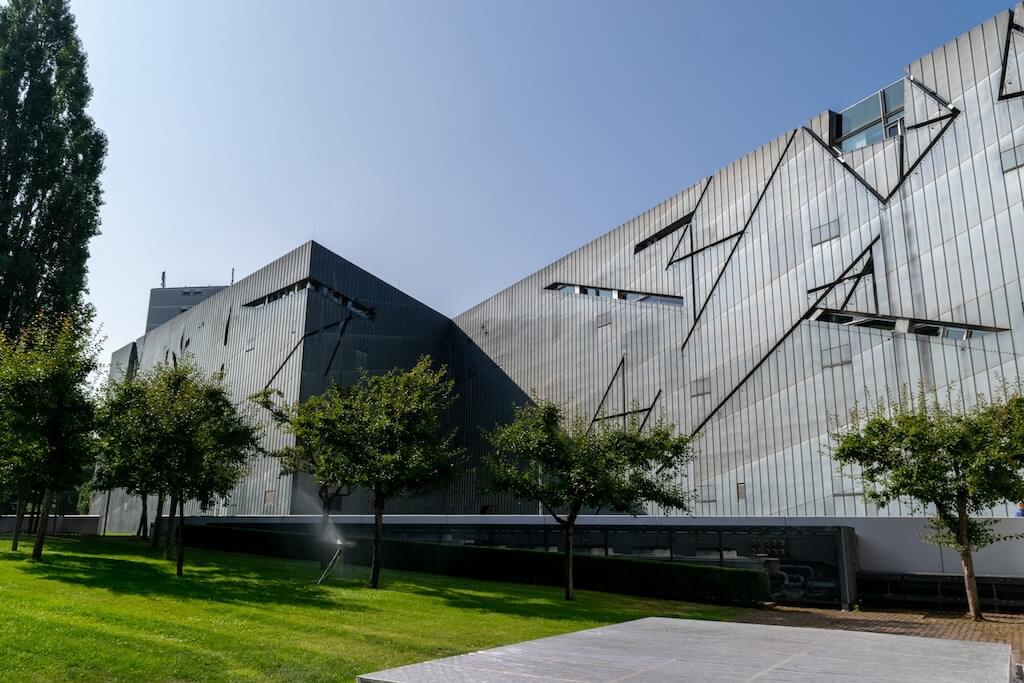
The Jewish Museum Berlin in Kreuzberg presents Jewish history and culture in Germany. It is not the first museum of its kind in the city: the original Jewish Museum opened next to the New Synagogue in 1933 and was forced to close in 1938. The idea of a new Jewish museum emerged in West Berlin in 1971. Daniel Libeskind won the design competition in 1989 with a scheme he called “Between the Lines,” the cornerstone was laid in 1992, and the Jewish Museum Berlin opened as an independent museum on September 13, 2001.
You enter through a baroque building on Lindenstraße and reach the Libeskind building underground. The museum describes how Libeskind organized the building around two lines, a visible zigzag and an invisible straight line; where they cross, empty concrete “voids” cut through the building, making the loss caused by the destruction of Jewish life visible as empty space. Three underground axes stand for exile, the Holocaust and continuity. The Axis of the Holocaust ends in the Holocaust Tower, an unheated concrete shaft lit only through a narrow slit, and the Axis of Exile leads to the Garden of Exile, 49 concrete stelae on sloping ground with Russian olive bushes growing from them. The museum’s own guide to the Libeskind building explains these spaces in more detail.
Visiting: open Tuesday to Sunday and closed on Mondays; the museum recommends booking a time-slot ticket online. Allow at least two to three hours.
Memorial to the Murdered Jews of Europe
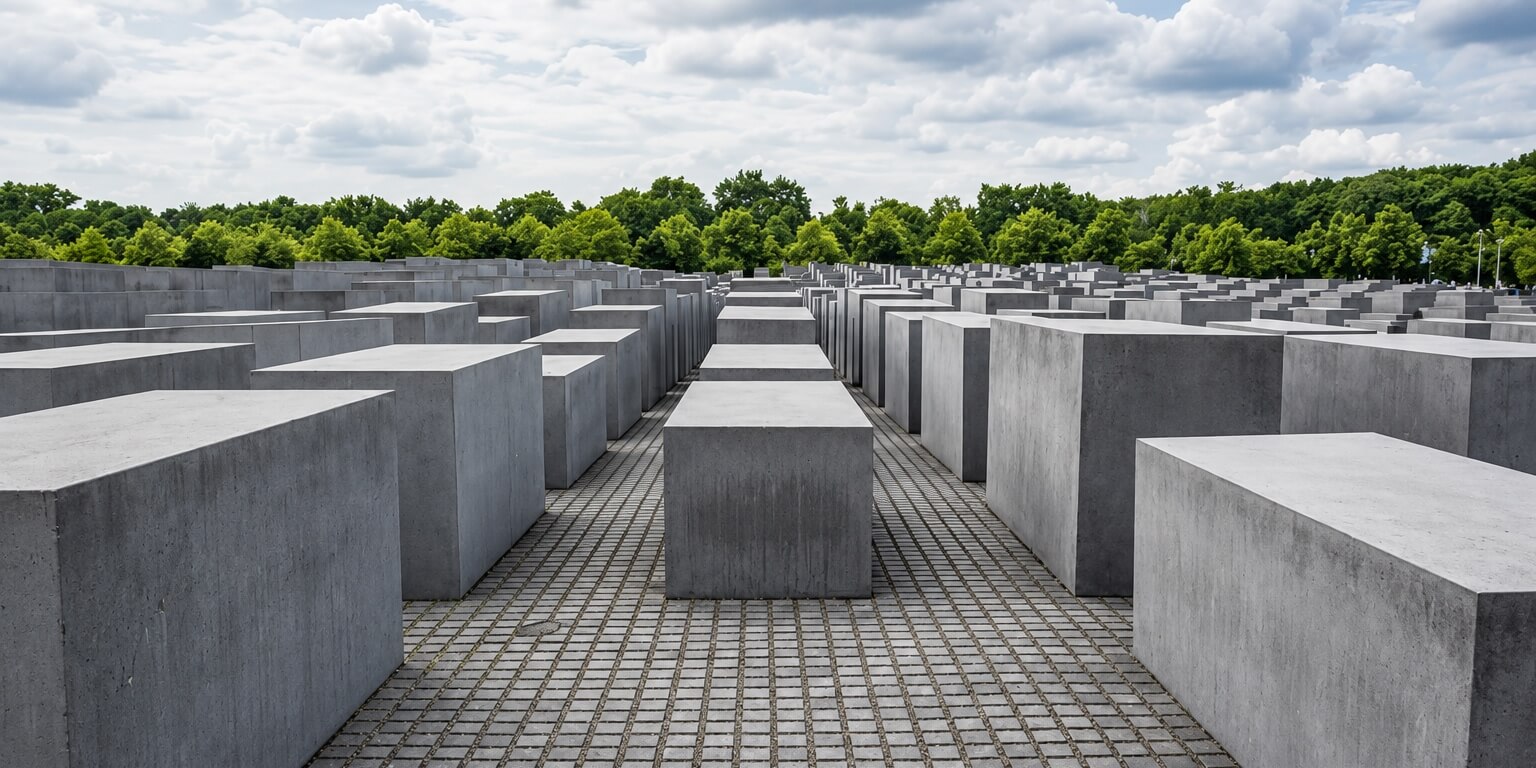
Germany’s central memorial to the Jewish victims of the Holocaust stands a few minutes south of the Brandenburg Gate. The German Bundestag decided to build it in June 1999, and it opened on May 10, 2005. Peter Eisenman’s Field of Stelae consists of 2,711 concrete stelae on sloping ground, accessible at all hours. There is no set route; walking into the field, rather than viewing it from the edge, is the best way to experience it.
Beneath the field, the Information Centre documents the persecution and murder of the Jews of Europe and the historical sites of the crimes, with rooms that present personal documents, family histories, the names of victims and the sites of the crimes. It is free, closed on Mondays, and entered through a security check that can mean a wait. The memorial foundation’s website has current details.
This memorial is dedicated specifically to the Jewish victims. The same foundation maintains separate memorials to the Sinti and Roma of Europe murdered under National Socialism, to homosexual people persecuted under National Socialism, to the victims of the Nazi “euthanasia” murders and to the Jehovah’s Witnesses persecuted and murdered under National Socialism.

Platform 17 Memorial at Grunewald
Deportations of Jews from Berlin began on October 18, 1941, from Grunewald station in the southwest of the city. Since January 27, 1998, the Platform 17 (Gleis 17) Memorial has listed every deportation train that left Berlin on 186 cast-steel plates along the platform edge, with its date, the number of people deported and its destination. The vegetation growing between the rails has been left on purpose: no train will leave from this track again. The memorial is open to the public and reached from Grunewald S-Bahn station.
Stolpersteine
As you walk through Berlin, you will see small brass plaques set into the sidewalk. These are Stolpersteine (“stumbling stones”), a project by the artist Gunter Demnig, laid in Berlin since 1996 in front of the last freely chosen homes of people persecuted by the Nazis. Each records a name and a fate. Many commemorate Jewish Berliners; others remember Sinti and Roma, political and religious opponents, victims of the “euthanasia” murders, homosexual people and others. They are found throughout the city rather than in one place, and the Stolpersteine in Berlin website lets you search by street.
Jewish cemeteries in Prenzlauer Berg and Weißensee
Berlin has four surviving Jewish cemeteries. Two are still in use, at Weißensee and Heerstraße; the cemeteries on Große Hamburger Straße and Schönhauser Allee are closed for burials. In Jewish tradition a cemetery is a place of eternal rest that must never be cleared, so visit as you would any place of mourning.
Schönhauser Allee Jewish Cemetery
Opened in 1827 to replace the cemetery on Große Hamburger Straße, the Schönhauser Allee cemetery in Prenzlauer Berg holds around 22,500 individual graves and 750 family tombs, including those of the painter Max Liebermann, the composer Giacomo Meyerbeer and the publisher Leopold Ullstein. It closed for new burials when Weißensee opened in 1880, though burials in existing family plots continued for some decades. It is closed on Saturdays, Sundays and public holidays, and on Jewish holidays.
Weißensee Jewish Cemetery
The Weißensee cemetery was consecrated on September 9, 1880, as the successor to Schönhauser Allee, not to the older cemetery on Große Hamburger Straße. Covering 42 hectares (about 104 acres) with more than 115,000 graves, it is described by the Jewish Community of Berlin as the largest Jewish cemetery in Europe, and its burial register survives complete.
During the Nazi years the rabbi Martin Riesenburger and his wife survived on the grounds, where he hid Torah scrolls and ritual silver and led a service again on May 11, 1945. The cemetery includes a field of honor for Jewish soldiers who fell in the First World War, the grave of the resistance fighter Herbert Baum, and, near the entrance, a memorial to the victims of the Shoah. It is an active cemetery where burials still take place.
Visiting: the cemetery is open Monday to Thursday and on Sundays, with shorter hours on Fridays, and is closed on Saturdays and Jewish holidays; hours are shorter in winter. Check the Jewish Community of Berlin’s cemetery page before you go and follow the instructions of cemetery staff.
Jewish Berlin today
Jewish life in Berlin today includes several congregations and religious traditions, schools, cultural institutions and a strong secular and artistic scene, with members of many different backgrounds and countries of origin. It is not a single, uniform community, and its institutions operate under police protection.
Active synagogues are places of worship, not museums. Casual visits are generally not possible; where visits are offered, they usually need to be arranged in advance and involve identification and security checks. The New Synagogue – Centrum Judaicum is the best place to see the inside of a historic synagogue and learn about Jewish life past and present. For current Jewish cultural events, visitBerlin keeps a Jewish Berlin listing.
Sachsenhausen: a separate visit
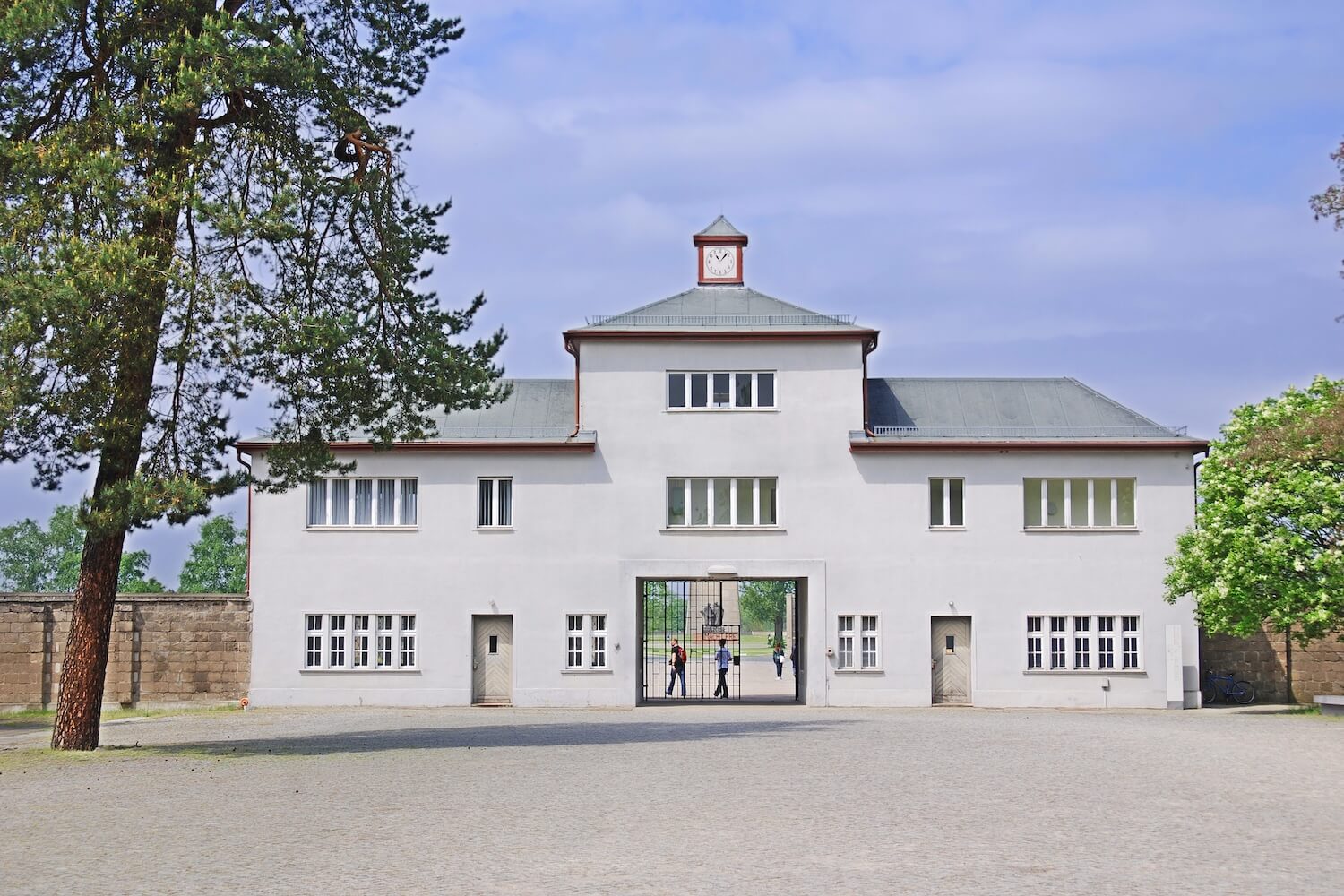
Sachsenhausen is not part of Jewish Berlin in the narrow sense, but it is closely connected with the history of Nazi persecution in and around the city. The former concentration camp in Oranienburg, north of Berlin, was established in 1936 as a model camp and training site for the SS. More than 200,000 people were imprisoned there between 1936 and 1945: political opponents of the regime, Jews, Sinti and Roma, people persecuted as homosexuals and others labeled “asocial” or “criminal,” and, after 1939, tens of thousands of people deported from occupied countries, including prisoners of war. Tens of thousands died from hunger, disease, forced labor, medical experiments and mistreatment, or were murdered by the SS; in the autumn of 1941 alone, the SS murdered at least 10,000 Soviet prisoners of war, many of them Jews. After the war, the Soviet occupation authorities used the site as a special camp until 1950.
Today the Sachsenhausen Memorial and Museum is a memorial site with several exhibitions. Admission is free. Allow a full half day including travel; the S1 S-Bahn takes about 45 minutes from Friedrichstraße to Oranienburg, followed by a 20-minute walk or a bus ride. The memorial does not recommend a visit for children under 14, and guides who lead visitors on the grounds must hold a license issued by the memorial. Current information is on the Sachsenhausen Memorial and Museum website.
Because of the distance and the weight of the subject, Sachsenhausen is best visited on its own day rather than added to a full day of Jewish heritage sites in the city.
Planning a Jewish heritage itinerary in Berlin
- A half day in Mitte: the Spandauer Vorstadt on foot, with the New Synagogue – Centrum Judaicum, the Old Jewish Cemetery on Große Hamburger Straße, the Otto Weidt museum, Heidereutergasse and Rosenstraße.
- A full day: add the Memorial to the Murdered Jews of Europe and either the Jewish Museum Berlin or the Platform 17 Memorial, which are in different parts of the city and best reached by public transport or car.
- A second day: the Schönhauser Allee and Weißensee cemeteries, plus anything you have not had time for; or Sachsenhausen on its own.
A few practical points help. Many museums and the Holocaust memorial’s Information Centre are closed on Mondays, and the Jewish cemeteries are closed on Saturdays and Jewish holidays. Expect security checks at Jewish institutions and leave large bags at your hotel. Photography is not appropriate everywhere; follow posted signs and staff instructions, and be considerate of mourners and worshippers.
If your family has roots in Berlin, the city’s archives and the cemeteries’ surviving records can sometimes help you find a grave, an address or a Stolperstein. Our article on Berlin ancestry tours explains where that research usually begins.
Exploring Jewish Berlin with a private guide
Jewish Berlin is difficult to see well on your own. The sites are spread across several districts, they belong to very different periods, and some of the most important, such as Heidereutergasse or the Old Jewish Cemetery, show very little without context. A private guide can connect them into one coherent story, adjust the pace and route to your interests and mobility, and plan around closing days and security arrangements.
Our private half-day tour of Berlin’s historic Jewish neighborhood explores the Spandauer Vorstadt on foot, including the Old Jewish Cemetery, Otto Weidt’s workshop and the New Synagogue. Our full-day Berlin Jewish history and heritage tour adds sites across the city, such as the Memorial to the Murdered Jews of Europe, the Jewish Museum Berlin, the Platform 17 Memorial and a historic Jewish cemetery, with a private vehicle where helpful. For other wartime sites, see our guide to World War II sites in Berlin.
If you would like an itinerary built around a particular interest or your own family’s history, we can plan a tailor-made tour for you, or you can contact our Berlin team with your dates and questions.
Frequently asked questions about Jewish Berlin
The New Synagogue – Centrum Judaicum, the Old Jewish Cemetery on Große Hamburger Straße, the Jewish Museum Berlin, the Memorial to the Murdered Jews of Europe, the Platform 17 Memorial at Grunewald and the Jewish cemeteries on Schönhauser Allee and in Weißensee are the most important. Together they cover Jewish life in Berlin from the seventeenth century to today.
There is no official Jewish quarter. The Spandauer Vorstadt in Mitte, including the Scheunenviertel, was the historic center of Jewish institutions and is often called the Jewish quarter, but Jewish Berliners have always lived throughout the city, and many important sites are elsewhere.
You can visit the New Synagogue – Centrum Judaicum, which is a museum with a small active congregation; expect security procedures and bag-size limits. Other active synagogues are places of worship; visits are generally possible only by prior arrangement, with identification and security checks.
Allow at least two to three hours to see the Libeskind building and the core exhibition. The museum is closed on Mondays and recommends booking a time-slot ticket online.
Yes. It is an active cemetery that is open to visitors from Sunday to Friday, with shorter hours on Fridays and in winter, and closed on Saturdays and Jewish holidays. Check the Jewish Community of Berlin’s website for current hours before you go.
You can see the Spandauer Vorstadt, the Memorial to the Murdered Jews of Europe and one more major site, such as the Jewish Museum Berlin, in one full day. The cemeteries, the Platform 17 Memorial and Sachsenhausen are best left for a second day.
Sachsenhausen is a former concentration camp in Oranienburg, north of Berlin, where people from many persecuted groups were imprisoned and murdered, including Jews. It is now a memorial and museum. It is not usually considered part of Jewish Berlin as a heritage itinerary and is best visited separately.