


One Day in Berlin: A Realistic Itinerary for First-Time Visitors
One day in Berlin is enough to understand how the city’s turbulent twentieth century fits together, as long as you stay in one compact area and resist the urge to see everything. The route below starts at the Berlin Wall Memorial, crosses the government district to the Brandenburg Gate and the Topography of Terror, and ends on Museum Island and around Hackescher Markt, with one museum visit, two proper meals and an optional late visit to the Reichstag dome.
It is a full morning-to-evening plan for travelers who have a single day, or 24 hours in Berlin between flights, trains or a cruise. It works best from Tuesday to Sunday. If your day falls on a Monday, read the Monday note in the FAQ first, because several indoor sites close.
Your one-day Berlin itinerary at a glance
- 9:30 a.m. Berlin Wall Memorial, Bernauer Strasse (about 75 minutes; free; mostly outdoors)
- 10:45 a.m. S-Bahn from Nordbahnhof to Brandenburger Tor (about 10 minutes door to door)
- 11:00 a.m. Brandenburg Gate, Pariser Platz and the Reichstag building from outside (30 minutes)
- 11:30 a.m. Memorial to the Murdered Jews of Europe (30 to 45 minutes)
- 12:15 p.m. Walk down Wilhelmstrasse to the Topography of Terror (15-minute walk; allow an hour inside; free)
- 1:30 p.m. Lunch between Checkpoint Charlie and Gendarmenmarkt
- 2:45 p.m. Gendarmenmarkt, Bebelplatz and Unter den Linden on foot (45 minutes)
- 3:30 p.m. One indoor attraction around Museum Island (about 90 minutes; ticketed)
- 5:15 p.m. Hackescher Markt, or the TV Tower around sunset (time-slot ticket)
- 7:00 p.m. Dinner in Mitte
- 9:00 p.m. Optional: the Reichstag dome after dark (free; advance registration required)
Expect approximately 7–9 kilometers (4.5–5.5 miles) on foot, depending on museum entrances and optional detours, plus two short rides on public transport. The core route stays within Mitte and avoids crossing the city twice.

What to book before you go
Most of this day is free and needs no reservation. Three things are worth sorting out in advance, and the rest you can leave to the day.
Reichstag dome. Entry is free, but you must register ahead with the German Bundestag’s online visitor registration, giving each visitor’s name and date of birth. Bring a passport or other official photo ID, because identity is checked at the entrance and there is a security screening. If you have not registered, the Bundestag’s service point near the building issues same-day places when there is space, from two hours before a slot. The dome itself closes for cleaning on a few scheduled dates each year; the roof terrace stays open.
Museum Island. The State Museums recommend booking tickets online to avoid waiting at the ticket desk. The Neues Museum is closed on Mondays.
Berlin TV Tower. Tickets for the observation deck are tied to a time slot. There is an airport-style security check, large bags are not allowed, and there are no lockers. The tower is not accessible to wheelchair users or to visitors who cannot walk without assistance.
It also helps to know which kind of stop you are dealing with:
- Free, outdoors, no booking: the Berlin Wall Memorial grounds, the Brandenburg Gate, the Field of Stelae at the Holocaust memorial, the East Side Gallery
- Free, but with a security check: the Reichstag dome (registration required) and the Information Centre beneath the Holocaust memorial
- Free indoor exhibition: the Topography of Terror
- Ticketed: the Museum Island museums, Berlin Cathedral, the TV Tower and the Jewish Museum Berlin
Visitor details in this guide were checked in October 2026. Opening hours and closures change, so confirm on each official website a few days before your visit.

Five minutes of Berlin history before you start
Berlin makes far more sense once you can place what you are looking at. These are the periods you will walk through today:
- 1701 to 1871: capital of the Kingdom of Prussia, which built the grand boulevard of Unter den Linden and the first museums on Museum Island
- 1871 to 1918: capital of the German Empire, the era of the Reichstag building and Berlin Cathedral
- 1918 to 1933: the Weimar Republic, Germany’s first democracy
- 1933 to 1945: the Nazi dictatorship and the Second World War, which left much of the center in ruins
- 1945 to 1990: occupation and division; the Berlin Wall stood from August 13, 1961, until November 9, 1989
- Since October 3, 1990: capital of a reunified Germany, with the parliament sitting in the rebuilt Reichstag since 1999
If you want the longer story first, our guide to Berlin’s culture through the years traces how each era shaped the city.
Morning: the Berlin Wall where it actually stood
Berlin Wall Memorial on Bernauer Strasse
Start where the division of the city is easiest to grasp. On Bernauer Strasse the border ran along the house fronts themselves: the buildings stood in East Berlin while the sidewalk outside belonged to the West. In August 1961, residents climbed and jumped from their windows to escape before the windows were bricked up.
The memorial’s outdoor exhibition follows the former border strip along the street and is open every day from 8 a.m. to 10 p.m. At its heart is a preserved section of the Wall with its patrol strip and watchtower, best seen from the observation tower of the Documentation Center across the street, which opens at 10 a.m. from Tuesday to Sunday. Admission is free. Seventy-five minutes gives you time for the central section, the Chapel of Reconciliation, which stands where the border regime demolished a church, and the viewing tower without rushing.
If the Cold War is the part of Berlin you most want to understand, our private Berlin Wall and Cold War tour adds the human stories this landscape cannot tell on its own.

Getting to the Brandenburg Gate
From the memorial, walk to Nordbahnhof station and take any southbound S-Bahn train three stops to Brandenburger Tor. Allow about 10 minutes door to door.
Late morning: the Brandenburg Gate, the Reichstag and the Holocaust memorial
Pariser Platz and the Reichstag building
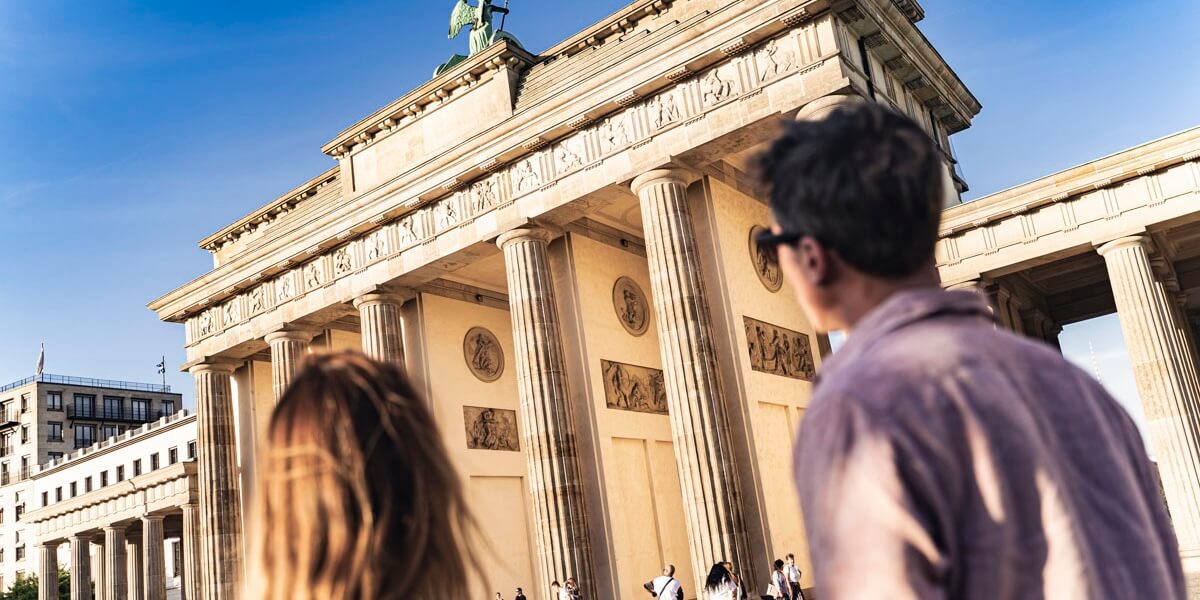
You come up beside the Brandenburg Gate, completed in 1791 and, for 28 years, stranded in the border zone where neither East nor West Berliners could reach it. Walk through the gate onto Pariser Platz, then five minutes north to see the Reichstag building and its glass dome from outside. If you booked the dome for the evening, as we suggest, you will be back later.
Memorial to the Murdered Jews of Europe
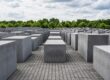
Five minutes south of the gate is Germany’s central Holocaust memorial, opened in 2005: a field of about 2,700 concrete stelae designed by the architect Peter Eisenman. The Field of Stelae is open around the clock, and walking into it, rather than looking at it from the edge, is the point. The underground Information Centre documents the persecution and murder of Europe’s Jews. Entry is free, it is closed on Mondays, and there is a security gate that can mean a short wait.
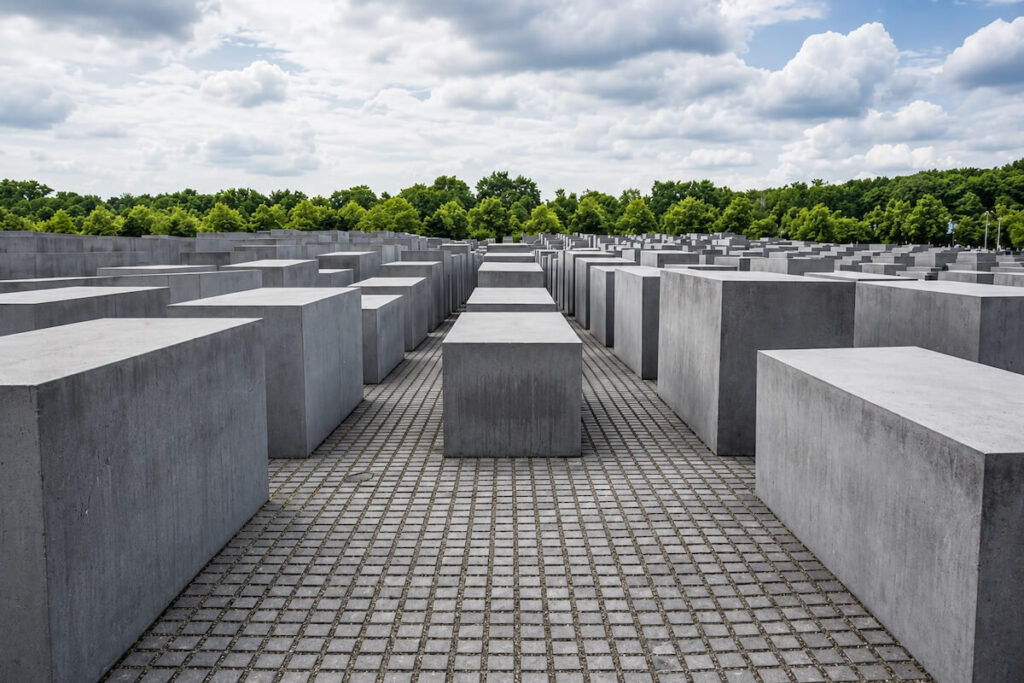
Midday: Nazi Berlin along Wilhelmstrasse
Topography of Terror
From the memorial, walk south along Wilhelmstrasse, once the street of Germany’s government ministries. You pass a small information board marking the site of Hitler’s bunker, where there is nothing left to see, and then the vast former Reich Aviation Ministry, which survived the war and now houses Germany’s Federal Ministry of Finance.
The Topography of Terror stands on the site of the headquarters of the Gestapo, the SS leadership and, from 1939, the Reich Security Main Office. Its documentation center is free and open daily from 10 a.m. to 8 p.m., and a surviving stretch of the Berlin Wall runs along the edge of the grounds on Niederkirchnerstrasse. An hour is enough for the main exhibition.
For more places connected to this period, see our guide to World War II sites in Berlin. If you would like to explore it in depth with a guide, our private Third Reich tour of Berlin gives the subject a full day.
Lunch near Checkpoint Charlie and Gendarmenmarkt
Five minutes east is Checkpoint Charlie, the Allied crossing point on Friedrichstrasse where American and Soviet tanks faced each other in October 1961. Today it is crowded and commercial, but it is worth a brief look, and an outdoor exhibition by the Berlin Wall Foundation explains the crossing’s history. Keep walking north toward Gendarmenmarkt for a calmer lunch: the side streets around the square have plenty of restaurants, and a sit-down meal here is the best way to recharge for the afternoon.

Afternoon: Prussian Berlin and Museum Island
Gendarmenmarkt, Bebelplatz and Unter den Linden
Gendarmenmarkt, framed by the Konzerthaus and the matching French and German churches, has reopened after a two-year renovation and is often called Berlin’s most beautiful square. From there, walk north to Bebelplatz. On May 10, 1933, Nazi students burned thousands of books here, and Micha Ullman’s memorial, a sunken room of empty shelves beneath a glass panel in the pavement, marks the spot. The State Opera and Humboldt University line the square, and Unter den Linden leads you east toward Museum Island. Our guide to famous buildings in Berlin covers the architecture along this stretch in more detail.
Choose one indoor attraction around Museum Island
Museum Island is a UNESCO World Heritage Site with five major museums, and the most common mistake is trying to see several of them in one afternoon. Pick one:
- Neues Museum for ancient Egypt and the bust of Nefertiti, in a building rebuilt by David Chipperfield. Closed on Mondays.
- Berlin Cathedral for the imperial church interior, the Hohenzollern crypt, which has reopened after restoration, and the view from the dome walkway. The dome is reached by stairs and is not accessible to visitors with reduced mobility.
- Pergamonmuseum. Das Panorama if you are curious about the Pergamon collection. The Pergamonmuseum itself has been closed for renovation since October 2023 and is scheduled to begin reopening in 2027, so do not plan around it until it does.
Ninety minutes in one museum will stay with you longer than half an hour in three.

Evening: Hackescher Markt, the TV Tower and the Reichstag dome
Sunset and dinner in Mitte
From Museum Island, walk north along the Spree to Hackescher Markt and the courtyards of the Hackesche Höfe. If you would rather see the city from above, the TV Tower at Alexanderplatz is a 10-minute walk away. It was completed in 1969 as a showpiece of East Germany, and its observation deck is open until 11 p.m.; book a slot around sunset.
For dinner, stay in the streets around Hackescher Markt and the Scheunenviertel, the historic heart of Jewish Berlin, where you will find everything from relaxed wine bars to fine dining. Reserve ahead on Fridays and Saturdays. If the history of this neighborhood interests you, our private tour of Berlin’s Jewish neighborhood is a good way to start a second day.
The Reichstag dome after dark
End the day where Germany’s parliament meets. The dome is generally open until midnight, with the last admission currently at 9:45 p.m., and the city lights make the spiral ramp especially memorable. Check the Bundestag website for scheduled closures and changes before your visit. From Alexanderplatz or Museumsinsel station, the U5 subway line runs directly to Bundestag station in about 10 minutes. Arrive a little before your slot and bring the photo ID you registered with.

Swap this, not that: alternatives by interest and weather
- Jewish history: spend the afternoon at the Jewish Museum Berlin instead of Museum Island. It is about a 15-minute walk south of Checkpoint Charlie, open Tuesday to Sunday, and deserves at least two hours. The museum recommends booking a time-slot ticket online.
- Street art and the Wall: swap the TV Tower for the East Side Gallery, 1.3 kilometers of the Wall painted by 118 artists in 1990 and now a listed historic monument. It is free and open around the clock, near Warschauer Strasse and Ostbahnhof stations. Look, take photos and read the visitor information, but please do not write or paint on the Wall: the artworks have had to be restored repeatedly because of graffiti damage.
- Modern art: the Berlinische Galerie, Berlin’s museum of modern art, photography and architecture, is a short walk from the Jewish Museum and is closed on Tuesdays. Hamburger Bahnhof – Nationalgalerie der Gegenwart, near the main train station, is the city’s museum of contemporary art.
- A rainy day: the Topography of Terror, your Museum Island choice and the Jewish Museum are all indoors, and the Field of Stelae is striking in the rain. Skip the TV Tower if the clouds are low.
- Less walking: take the U5 between Brandenburger Tor, Museumsinsel and Alexanderplatz, or travel with a private guide and a vehicle so the distances stop mattering.

What to save for your next visit
One day in Berlin will not cover everything, and it is not supposed to. Leave Potsdam’s palaces and the Sachsenhausen memorial for a second day; both are within reach of the city and need a full day to do them justice. Our guide to historical excursions from Berlin explains how to plan them. The western districts around Charlottenburg Palace and the Kurfürstendamm also deserve their own visit.
Would a private guide help with one day in Berlin?
If your time is short, a private guide removes most of the planning: no maps, no ticket lines to research, and a route built around your interests and pace. Our Must-See Berlin private history and highlights tour covers the heart of this route, from the Reichstag and the Brandenburg Gate to the Topography of Terror, Checkpoint Charlie, Gendarmenmarkt and Bebelplatz, and ends near Museum Island. It lasts about five hours, includes pick-up from your hotel, and can be done on foot with public transport or with a private vehicle and driver.
If you are combining Berlin with other cities, have mobility needs or simply want a day planned around your family’s interests, we can build a tailor-made itinerary for you. Or contact our Berlin team with your dates and we will suggest what fits.
If one thing is sure, it’s that you could spend months in Berlin and not even scratch the surface of our immense, sprawling city. We think of it like an onion – each time you peel off a layer, you simply find another one to explore underneath. However, sometimes as much as you wish you had more time, you only have one day in Berlin – and it’s our job to help you make the most of your visit.
Our team are architects, historians, actors, activists, academics and all-round experts on the city of Berlin: here’s what we’d advise you to do if you only have 24 hours.
Frequently asked questions about one day in Berlin
One day is enough to see Berlin’s essential landmarks and understand its history from the Prussian kings to the fall of the Wall, if you stay in the central district of Mitte and visit only one museum. It is not enough for Berlin’s museums, its neighborhoods or excursions to Potsdam and Sachsenhausen, so most visitors who can stay longer are glad they did.
Prioritize the Berlin Wall Memorial on Bernauer Strasse, the Brandenburg Gate, the Memorial to the Murdered Jews of Europe, the Topography of Terror and one museum on Museum Island. If you can register in advance, add the Reichstag dome in the evening.
Many museums close on Mondays, including the Neues Museum, the Jewish Museum Berlin, the Information Centre at the Holocaust memorial and the Documentation Center at the Berlin Wall Memorial. On a Monday, the outdoor sites on this route stay open, as do the Topography of Terror, the Reichstag dome and the TV Tower. On Sundays, museums and restaurants are open but most shops are closed.
Yes. A visit to the Reichstag dome is free but requires registration with the German Bundestag, and every visitor must show official photo ID at the entrance. If you have not registered, you can ask for a same-day place at the Bundestag’s service point near the building, but places are not guaranteed.
Yes, but plan carefully. Baltic cruises that offer Berlin as a port of call usually dock at Warnemünde or Rostock, roughly three hours from the city by road each way, which leaves around five or six hours in Berlin. Our private shore excursion from Warnemünde or Rostock includes pick-up at the pier, a private driver and a city tour planned around your ship’s schedule.
Expect approximately 7–9 kilometers (4.5–5.5 miles) on foot over the day, depending on museum entrances and optional detours, on mostly flat, paved streets, plus two short rides on public transport. To reduce walking, use the U5 subway line through the center or book a private tour with a vehicle.